

The true origins of Do-It-Yourself (DIY) Artificial Pancreas Systems are hard to trace.
Since the discovery of insulin almost a hundred years ago, individuals and families have longed for better and more effective technology to manage diabetes.
This timeline will not be able to name every individual who made this dream possible. However, we should honour the work and sacrifice of countless people who made living with diabetes a little easier.
I would also like to mention The Open Project, which brought together an international consortium of patient innovators, clinicians, social scientists, computer scientists and patient advocacy organisations to investigate various aspects of DIY Artificial Pancreas Systems (DIYAPS).
If you find any discrepancies, have important data to add, or just want to say hi: hello@thediabeticsurvivor.com 🙂
DIY Systems
Nightscout (2013)
The Nightscout project gave shape to the #wearenotwaiting movement. It started when John Costik, the father of a young child with diabetes, developed a simple piece of code to access his child’s CGM values in real time through a cloud infrastructure.
The project grew exponentially as thousands of parents and people living with diabetes — frustrated by the slow pace of progress in the medical industry — joined in from around the world.
OpenAPS (2015)
In 2014, Dana Lewis became the first person living with diabetes to close the loop. Building on the Nightscout project and the work of individuals like Ben West — who reverse-engineered a Medtronic pump — Dana was able to transmit her CGM data to a microcomputer connected to her pump, which used decision algorithms to instruct the pump automatically.
In 2015, Dana Lewis shared the full roadmap as an open-source project called OpenAPS.

Loop (2016)
In 2016, Nate Racklyeft developed a DIY looping system hosted on an iPhone — an iOS application that could receive real-time CGM data and use prediction algorithms to instruct an insulin pump. A device called the RileyLink acted as a radio bridge between the phone and the pump.
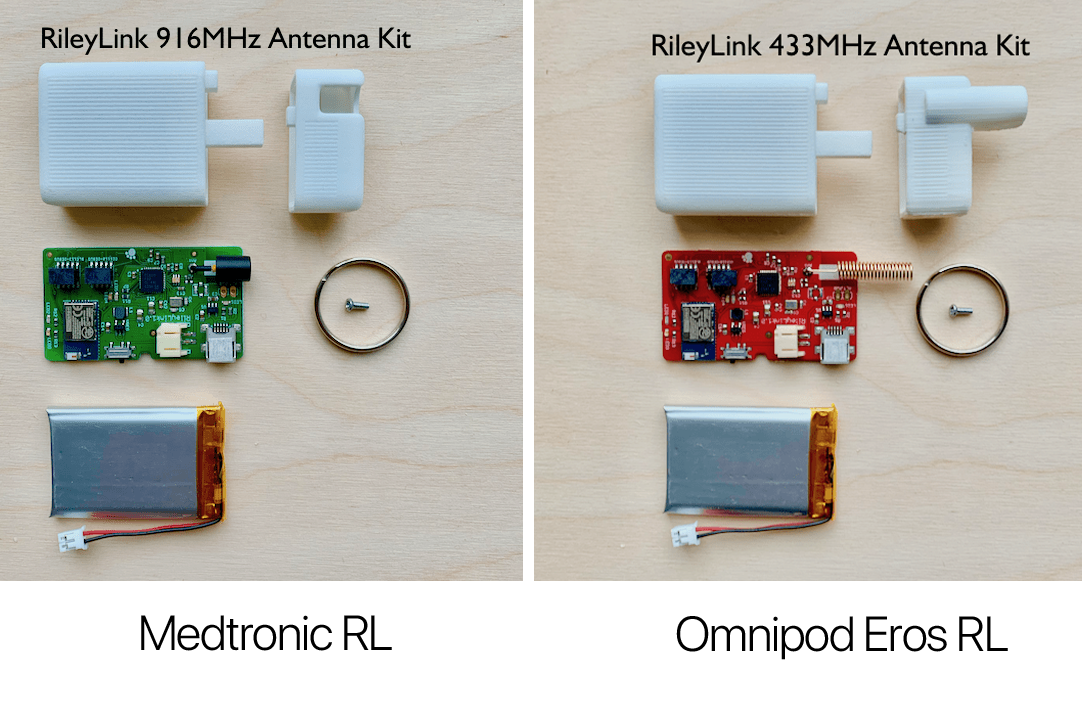
For more on Loop, the Loop and Learn YouTube channel is an excellent resource.
AndroidAPS (2016)
Loop was limited to iOS devices. In mid-2016, Milos Kozak and others developed AndroidAPS — the first open-source artificial pancreas system compatible with Android. AndroidAPS adjusts insulin dosages based on real-time glucose readings and is compatible with a wide range of pumps and CGMs. It remains one of the most actively developed DIY APS projects today.
iAPS / Trio (2021–present)
Building on OpenAPS and Loop, iAPS (later forked and developed as Trio) brought the Oref1 algorithm — originally from OpenAPS — to iOS. It introduced features like dynamic insulin sensitivity correction and improved meal management. Trio in particular has grown a strong community following, particularly among people who want the flexibility of a DIY system with more advanced algorithm options than the original Loop provided.
Commercial Systems
While the #wearenotwaiting movement was building open-source solutions, commercial companies were also developing hybrid closed-loop systems for the market.
Medtronic MiniMed 670G (2017)
In 2017, Medtronic became the first company to receive FDA approval for a commercial hybrid closed-loop insulin delivery system. The MiniMed 670G combined the Minimed insulin pump with the Guardian 3 CGM sensor, automating basal insulin delivery based on CGM data. Bolus delivery remained manual.
CamAPS FX (2020)
Developed by the University of Cambridge and commercialised through CamDiab, CamAPS FX is an advanced hybrid closed-loop algorithm that runs on an Android smartphone. It uses machine learning to adjust insulin delivery based on real-time glucose readings, meal announcements, physical activity and individual patterns.
What makes CamAPS FX particularly notable is its interoperability: it works with the mylife YpsoPump insulin pump and is compatible with both the FreeStyle Libre 3 Plus and Dexcom G6 sensors — giving people living with diabetes genuine choice of hardware. It received a CE mark in 2020 and is now available in the UK, Germany, the Netherlands, Switzerland and other European countries.
It is the system I currently use — YpsoPump + FreeStyle Libre 3 Plus + CamAPS FX — and it has been a genuine life-changer.
Tandem Control-IQ (2020)
In 2020, Tandem released Control-IQ technology on the T:slim X2 insulin pump. Control-IQ optimises insulin delivery based on CGM readings and can automate corrective bolus doses to reduce time spent in hyperglycaemia — a step beyond what the Medtronic 670G offered.
Omnipod 5 (2022)
In 2022, Insulet received FDA approval for the Omnipod 5 — the first tubeless, wearable automated insulin delivery system. The Omnipod 5 integrates with the Dexcom G6 CGM and uses a SmartAdjust algorithm to automatically adjust insulin delivery every five minutes. Its tubeless design removed one of the last barriers for people who found traditional pump tubing impractical. The Omnipod 5 also introduced smartphone control, allowing the pod to be managed directly from an app.
Medtronic MiniMed 780G (2023)
Medtronic’s 780G brought fully automated bolus correction to a commercial system for the first time — not just basal adjustment, but automatic correction boluses when glucose exceeds a set threshold. Combined with the Guardian 4 sensor (which reduced mandatory fingerprick calibrations to zero), the 780G represented a meaningful step forward from the 670G.
Where we are now
As of 2025, the hybrid closed-loop landscape has expanded significantly. People living with diabetes in many countries now have access to multiple commercial systems — from Medtronic, Tandem, Insulet and CamDiab — as well as mature DIY options in Loop, AndroidAPS and Trio. Interoperability between devices from different manufacturers is growing, meaning people can increasingly mix and match sensors, pumps and algorithms rather than being locked into a single ecosystem.
The #wearenotwaiting movement didn’t just build technology. It changed what the industry believed was possible, and accelerated the commercial development of systems that are now improving the lives of hundreds of thousands of people living with diabetes worldwide.
References
- Nightscout — Development History
- OpenAPS Overview and Project History
- The History of Loop and LoopKit — Nate Racklyeft, Medium
- How the DIY Diabetes Community Made the Artificial Pancreas Possible — Labiotech
- The life-changing artificial pancreas — University of Cambridge
- MiniMed 670G Hybrid Closed Loop Artificial Pancreas System — NIH
- t:slim X2 with Control-IQ — ADA Consumer Guide